




Who Needs Another Yoga App? Why I Built Jyoti | YogaBuilder™
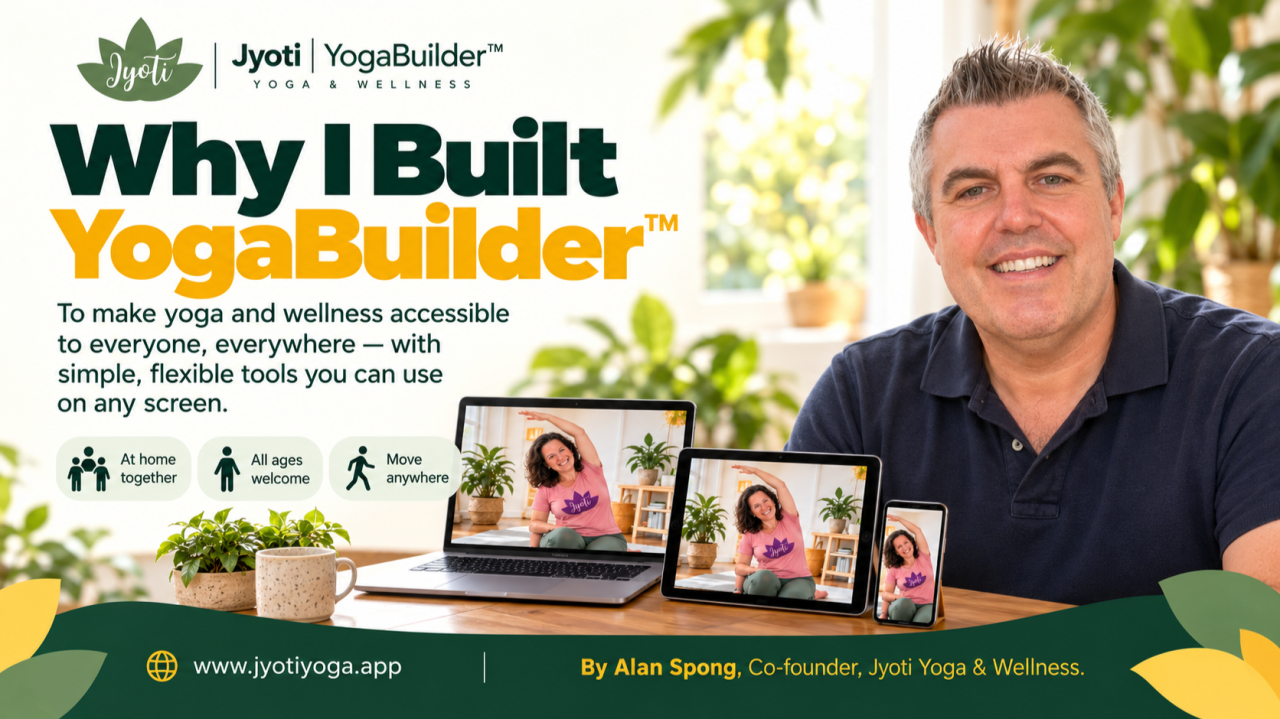
By Alan Spong, Co-founder & CTO, Jyoti Yoga & Wellness
It's a perfectly reasonable question. With thousands of yoga videos, fitness platforms, wellness subscriptions and exercise apps already available, why on earth would we decide to build another one? And perhaps more importantly, why would anyone need it?
When my partner and co-founder, Jyoti Harvey, and I first started discussing the idea, we knew we weren't entering an empty market. Quite the opposite. Yoga and digital wellbeing are already hugely competitive industries, with established global brands, enormous content libraries and some very sophisticated technology.
But having spent much of my career working in science, technology, innovation and business transformation, I've learned that a crowded market doesn't necessarily mean a problem has been solved. Sometimes it means there's considerable demand, but the existing solutions still don't work particularly well for everyone.
That's where our thinking began.
What 27 years of teaching yoga revealed
Jyoti has been teaching yoga for 27 years, working with people of different ages, abilities, backgrounds and levels of experience. Over that time, she's developed a deep understanding of something that isn't always obvious when browsing a fitness app: people rarely arrive wanting exactly the same thing, and what they need can change from one day to the next.
Someone might want to ease the stiffness they feel after sitting at a desk all day. Another person might be looking to maintain flexibility and confidence as they get older. Someone else might simply need ten minutes to unwind after a demanding day. Some people are comfortable practising on a mat, while others need the support of a chair or prefer to remain standing.
What struck me was how naturally Jyoti adapted her teaching to individuals. She wasn't trying to make everyone follow the same routine. She was responding to what was appropriate for the person in front of her.
We started asking ourselves whether modern technology could bring some of that flexibility and personal choice to people who couldn't attend her classes, wherever they happened to live.
The idea wasn't to replicate a traditional yoga class on a phone. It was to rethink how someone accesses yoga in the first place.
The research suggested a much bigger opportunity
As we explored the idea, we looked beyond the yoga industry and started examining some of the wider changes taking place in health, work and society.
The figures were difficult to ignore. According to the World Health Organization, approximately 1.8 billion adults worldwide, around 31% of the adult population, were not meeting recommended physical activity levels in 2022. WHO research has also estimated that approximately 1.71 billion people globally live with musculoskeletal conditions, including problems affecting the back, neck, joints and muscles.
These statistics don't mean that everyone affected needs yoga, or that yoga alone is the answer. But they demonstrate the enormous scale of the challenges surrounding physical inactivity, mobility and musculoskeletal health.
Meanwhile, the commercial market for yoga continues to expand. Research published by Grand View Research in 2026 estimates the global yoga market at approximately $127 billion in 2025, with forecasts suggesting further significant growth over the coming years. Importantly, that figure represents the wider yoga market, including classes and associated services, rather than simply revenue from yoga apps.
For us, the significance wasn't just the size of the market. It was the gap between how many people might benefit from accessible movement and how many feel that conventional yoga is relevant, comfortable or practical for them.
There are plenty of excellent yoga platforms serving experienced practitioners and people who enjoy structured classes. We didn't believe the world needed another app offering thousands of videos and asking people to search through them.
We saw an opportunity to do something different: start with the individual rather than the class.
Working from home has changed the way we move
One of the biggest changes in modern working life has been the growth of remote and hybrid working. While the pandemic accelerated this shift, working from home has become an established part of employment for millions of people, particularly across knowledge-based industries in the United States, Canada, Australia and the UK.
Gallup's 2026 research shows that among US employees whose jobs can be performed remotely, approximately 52% work in a hybrid arrangement and another 26% work entirely remotely. The traditional working environment has changed considerably, but our approach to everyday movement hasn't necessarily kept pace.
Think about a typical working day at home. You move from an early Teams or Zoom meeting into emails, reports, spreadsheets and more meetings. The journey between the meeting room and your desk has disappeared. Even the walk to the car, railway station or office canteen may no longer happen.
Of course, working from home offers enormous benefits, and not everyone becomes less active. But for people who spend most of their day at a screen, it's remarkably easy to remain in the same position for hours.
And this is where we felt conventional approaches to workplace wellbeing often missed an opportunity. Telling someone to attend a yoga class after work is fine, but what about the eleven o'clock gap between meetings? What about a quick movement break after a long video call, or five minutes of gentle stretching before starting the afternoon?
We wanted YogaBuilder™ to fit into these real working moments, rather than asking people to organise their day around another appointment.
Midlife, ageing and the people the fitness industry sometimes overlooks
The second major opportunity we identified was the changing age profile of society, particularly in developed economies.
People are living longer, working later into life and increasingly recognising the importance of maintaining mobility, strength, balance and independence. Yet much of the mainstream fitness industry still presents exercise through the lens of athletic performance, younger bodies and increasingly demanding routines.
For someone in their fifties who hasn't exercised regularly for years, or someone in their seventies looking to maintain confidence in their movement, that can be intimidating. They may not identify with the images, language or expectations of a conventional fitness platform.
But these are precisely the people who can have good reasons for wanting to introduce more appropriate movement into their lives.
Jyoti has worked with people across this spectrum for decades. She knows that someone doesn't need to be particularly flexible to begin yoga, that practising from a chair is entirely valid, and that gentle, supported movements can form part of a worthwhile practice.
We wanted that understanding built into the design of the app, not added as an afterthought.
For us, midlife and older adults aren't a secondary market. They're central to the opportunity we identified. And as populations continue to age, making appropriate movement accessible becomes increasingly important.
So what actually makes YogaBuilder™ different?
Our answer was to create a personalised session-building experience rather than another conventional library of classes.
With YogaBuilder™, users start by making a series of straightforward choices. How much time do they have? What's their experience and mobility level? Would they prefer chair-based, supported standing or mat-based movement? Which areas of the body would they like to focus on? What type of practice would suit them today, and would they like to include warm-up or relaxation?
The app then brings together selected content from Jyoti's real teaching videos to create a session shaped around those choices.
Someone working from home might build a short, gentle session focused on their neck, shoulders and back. Another person might choose a longer standing practice with a warm-up and relaxation. Someone with more limited mobility may prefer to practise from a chair.
The important point is that the user decides what suits them, rather than being expected to fit into a predetermined class.
Sessions can begin from just five minutes, because we believe removing the practical barriers to getting started matters enormously. Of course, five minutes isn't a substitute for meeting recommended weekly physical activity levels, but it's a manageable starting point for someone trying to make movement part of their routine.
We also developed what we call situational yoga, recognising that different circumstances create different opportunities for movement. That might be sitting at a desk, taking a break in the garden, travelling or winding down at the end of the day. Alongside YogaBuilder™, the app offers breathing practices, relaxation and audio experiences to support everyday wellbeing.
The principle behind it all is straightforward: your time, your body, your choice.
Building the technology without losing the teacher
Bringing that concept to life turned out to be a considerable undertaking.
Jyoti and I come from very different professional backgrounds, and that became one of the strengths of the project. Her experience provided the teaching expertise and understanding of how people move; my background brought the technology, systems thinking and product development approach needed to translate the idea into an app.
We built Jyoti Yoga & Wellness using modern app-development technology, including FlutterFlow, Firebase and cloud services, with AI-assisted development tools helping us accelerate parts of the process.
But there was an important decision we made early on. We didn't want an AI-generated yoga instructor telling people what to do. The actual teaching needed to come from Jyoti, through her real recorded videos and her years of professional experience.
Technology would provide the mechanism for personalisation, but the human teaching would remain at the centre of the experience.
Getting that right wasn't as simple as it sounds. We had to develop the way content was organised, build the session-selection logic, create an accessible user experience and work through the inevitable technical problems that come with developing and launching a new product.
There were plenty of setbacks and revisions along the way. As anyone who has brought a digital product to market will appreciate, there's a considerable difference between having an interesting idea and delivering something people can actually use.
In 2026, we launched the app on iOS and Android, turning what began as a conversation between a yoga teacher and a technology specialist into a real product available to people internationally.
The corporate wellbeing opportunity
As the app developed, another potential market became increasingly clear: employers looking for practical ways to support the health and wellbeing of their people.
Workplace wellbeing has become an important subject for business leaders, and for good reason. Musculoskeletal problems, stress and poor physical health can affect individuals and organisations alike. In Great Britain alone, the Health and Safety Executive estimated that work-related musculoskeletal disorders resulted in 7.1 million working days lost during 2024/25.
Similar challenges are recognised by employers and occupational health organisations across North America, Australia and other markets.
Many businesses already invest in employee wellbeing initiatives, but providing something that employees actually find convenient enough to use is a different challenge.
A scheduled weekly class may appeal to some employees, but it won't necessarily work for people on different shifts, hybrid teams, those working remotely or individuals who feel uncomfortable participating in group exercise.
We believe YogaBuilder™ offers an interesting alternative because it allows people to access movement and relaxation on their own terms. A five-minute session between meetings, a chair-based practice during a break or a longer session at home can all be part of the same wellbeing offering.
We're now exploring this opportunity through preferential corporate subscriptions, workplace demonstrations and pilot programmes with employers interested in giving their teams access to personalised movement and relaxation.
We aren't claiming that YogaBuilder™ has been proven to reduce corporate sickness absence or healthcare costs. That would require evidence from properly evaluated workplace programmes. But we do believe there's a compelling case for making accessible movement one part of a broader employee wellbeing strategy.
For business leaders, the question is not simply whether yoga is good for employees. It's whether they can provide a useful, inclusive wellbeing benefit that people have a realistic opportunity to use.
That's the opportunity we want to explore.
A crowded market doesn't mean there isn't room for a better approach
One of the questions people have asked me is how a relatively small company expects to compete with established international fitness and wellbeing brands.
It's a fair challenge.
We don't have the marketing budgets, enormous content libraries or brand recognition of some of the companies already operating in this space. And we're certainly not suggesting that other yoga apps don't have valuable things to offer.
But business innovation isn't always about doing more of what everyone else is doing. Sometimes it's about identifying the people whose needs aren't being adequately met and designing something specifically for them.
Our view is that there's a meaningful opportunity at the intersection of several major trends: an ageing population, growing awareness of musculoskeletal health, the normalisation of home and hybrid working, increasing interest in preventative wellbeing and advances in technology that make personalisation more accessible.
The research supports the existence and scale of those trends. What it doesn't yet prove is how large YogaBuilder™'s own addressable market will be, or how many people will ultimately choose our approach. That's something we have to establish through real-world adoption, customer feedback and ongoing development.
And that's precisely what makes this next stage exciting.
We're not trying to persuade every yoga enthusiast to abandon their favourite app. We're trying to reach people who might not have found a practical way to make yoga part of their lives in the first place.
Why we believe the timing is right
If you'd asked someone twenty years ago whether they would use their phone to attend a meeting, manage their finances, track their health and access personalised learning, they might have been sceptical.
Today, those things are part of everyday life.
We believe wellbeing is moving in a similar direction. People increasingly expect services that adapt to their circumstances, are accessible wherever they happen to be and don't demand unnecessary time or complexity.
For a busy professional, a person working from home, someone navigating midlife or an older adult wanting to maintain mobility, convenience and personal relevance matter.
But there's also a deeper point here. Technology has made us extraordinarily efficient at doing more things without moving very much. Perhaps it's time we put some of that same technological ingenuity into helping people move a little more.
Our ambition for Jyoti isn't simply to sell another wellness subscription. It's to make experienced, human-led yoga teaching more accessible to people who might otherwise struggle to find the time, confidence or suitable opportunity to practise.
We know we're at the beginning of that journey. There's much more to learn, new partnerships to develop and further improvements we want to make as people use the app.
But the underlying idea remains the same as it was when Jyoti and I first started talking about it: yoga should adapt to people's lives, rather than expecting their lives to adapt to yoga.
So, who needs another yoga app?
Perhaps not the person who's already perfectly happy attending regular classes or following their favourite instructor online. But what about the person stuck at a desk all day? The person who's beginning to feel less mobile in midlife? The older adult who doesn't see themselves represented in mainstream fitness? Or the employee who has five minutes available, but not an hour?
Those are the people we had in mind when we built YogaBuilder™.
And when you consider how many people around the world face those everyday challenges, we believe there's a very real opportunity to make a difference.
About Jyoti Yoga & Wellness
Jyoti Yoga & Wellness was founded by Jyoti Harvey, a yoga teacher with 27 years of experience, and Alan Spong, a scientist and technology and business transformation specialist. Its flagship YogaBuilder™ feature enables users to create personalised yoga sessions from five minutes using Jyoti's real teaching content, with chair-based, supported standing and mat-based options.
We welcome conversations with employers, HR leaders, business owners, wellbeing organisations and potential partners who share our interest in making movement more accessible.
Explore YogaBuilder™: https://jyotiyoga.app/
Watch how YogaBuilder™ works: https://youtu.be/b8mxRioaUn0
Corporate subscriptions and partnership enquiries: hello@jyotiyoga.app
Movement that fits your life.
Research and references
World Health Organization (2024), Nearly 1.8 billion adults at risk of disease from not doing enough physical activity. https://www.who.int/news/item/26-06-2024-nearly-1.8-billion-adults-at-risk-of-disease-from-not-doing-enough-physical-activity/
World Health Organization (2022), Musculoskeletal health. https://www.who.int/news-room/fact-sheets/detail/musculoskeletal-conditions
Gallup (2026), Hybrid Work and Productivity: What the Data Show. https://www.gallup.com/workplace/713093/hybrid-work-productivity.aspx
Grand View Research (2026), Yoga Market Size, Share and Trends, 2026–2033. https://www.grandviewresearch.com/industry-analysis/yoga-market-report
UK Health and Safety Executive (2025), Work-related musculoskeletal disorders statistics in Great Britain. https://www.hse.gov.uk/statistics/assets/docs/msd.pdf
Population health statistics, market estimates and workplace research provide context for the opportunity. They do not establish the clinical effectiveness or financial returns of YogaBuilder™.